

Overview
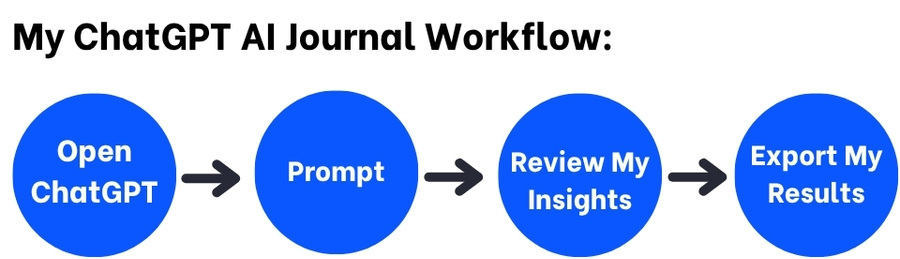
Journaling with Claude excels at long-context review. I reuse one Claude conversation, paste a short “Claude Journaling Coach” instruction, then run my AM/PM prompts, an optional voice flow (via device dictation or pasted transcript), and a weekly review that summarizes patterns across many entries. Each entry ends with a concise summary and one realistic next step. Start with the workflow below, then open the AI Journaling Hub for tool comparisons and prompts or see Best AI for Journaling.My Claude Journaling Workflow
- Set up once: Create a single “Daily Journal” chat and paste the Claude coach instruction below.
- AM prompt (3 min): intention → one focus → tiny action → 2-line summary.
- PM prompt (3 min): win → lesson → challenge → reframe → 2-line summary.
- Optional voice: dictate a 60–120s note (or paste a transcript); get a tidy takeaway + tag.
- Weekly review (10 min): Claude reads a longer span of entries to surface themes and two small experiments.
- Export/backup: keep weekly snapshots; stay portable across tools.
Step 1 — AI journal one-time setup
Goal: Reuse a single thread so Claude keeps context and your tone stays consistent.Paste this Claude journal instruction once
-
Act as my journaling coach. Keep a warm, concise, non-judgmental tone.
AM: ask intention, one focus, and one tiny action before noon.
PM: ask one win, one lesson, one challenge; offer a realistic reframe and one micro-improvement for tomorrow.
If I paste a short transcript, include it. For every entry, end with a 2-line summary and one tag (mood or topic). Keep outputs ≤120 words.
Why it matters
The instruction fixes tone and structure. You won’t re-explain daily. Consistency beats length.Step 2 — Claude morning check-in (AM)
Goal: Clarity and one doable action.Paste-ready AM prompt
-
It’s my AM entry. Ask me:
1) What matters today?
2) One focus?
3) One tiny action before noon.
Then return a 2-line summary and restate the action.
Tip: keep AM under 3 minutes. Put the action on your calendar.
Step 3 — Claude evening reflection (PM)
Goal: Close the loop and reset gently.Paste-ready PM prompt
-
It’s my PM entry. Ask me:
1) One win,
2) One lesson,
3) One challenge today.
Offer a realistic reframe and one micro-improvement for tomorrow. End with a 2-line summary.
Step 4 — Voice journaling (hands-free)
Goal: Capture thoughts fast; Claude tidies and tags.Paste-ready voice prompt
-
Transcribe this 60–120s voice note (or use device dictation). Clean wording. Ask one clarifying question.
Then summarize in 2 lines and add one tag (mood or topic).
Step 5 — Claude weekly review (10 minutes)
Goal: Use Claude’s long-context to see patterns and pick two experiments.Paste-ready weekly prompt
-
Using this week’s entries (paste the last 7 AM/PM summaries): list
• Themes,
• One highlight,
• One lesson,
• Two small experiments for next week.
Keep the output ≤120 words.
Step 6 — Optional add-ons
- Gratitude & reframe: 3 gratitudes → why they mattered → one gentle reframe.
- Mood tracking: 1–5 rating + one word; ask for a 2-line pattern snap on Fridays.
- Tags: add a simple tag per entry (energy, focus, relationship, health).
Step 7 — Journal export & backup
- Copy AM/PM summaries to Docs/Notion/Markdown weekly.
- Name files like
Journal-YYYY-MM-DD-wkNNfor easy search. - Keep a lightweight snapshot so you can switch tools later without losing history.
Step 8 — Claude privacy & safer prompts
- Redact names/identifiers; use initials or roles.
- For sensitive events, write privately first, then reflect on a condensed summary.
- Review account/data-sharing settings quarterly.
- Prefer local storage for raw details; sync summaries only.
My Copy-ready Claude journaling prompts
Bookmark these Claude journaling prompts. They match the AM/PM + voice + weekly workflow above.AM check-in
It’s my AM entry. Ask intention, one focus, and one tiny action before noon.
Return a 2-line summary and restate the action. Keep ≤120 words.
PM reflection
It’s my PM entry. Ask one win, one lesson, one challenge.
Offer a realistic reframe and one micro-improvement for tomorrow. End with a 2-line summary.
Voice to insight
Transcribe this 60–120s note (or pasted transcript). Clean wording. Ask one clarifying question.
Summarize in 2 lines and suggest one tag (mood or topic).
Weekly review
From this week’s entries: list themes, a highlight, a lesson, and two small experiments for next week. ≤120 words.Gratitude + reframe
Guide me through: 1) 3 gratitudes, 2) why each mattered, 3) one challenge, 4) a realistic reframe. End with a 2-line summary.